“THE GATE OF ABRAHAM: The Potential Identity of Universal Morality and the Path of Inquiry”
Mustafa Günen, Author
Abstract:
This article proceeds from the thesis that religion is an “innate behavioral program” found in the biological and neurological structure of humanity. This program is independent of all religious texts and teachings. While researching a definition of the “Muslim” identity with this level of inclusiveness, I examined many sacred texts, including the Torah and the Bible, to find clear statements supporting this idea. However, I found such a clear and principled expression, defining the identity as trans-historical and encompassing all believers, only in the Qur’an. It is due to this clarity and emphasis that I take the Qur’an as a reference point to explain this universal potential identity. The emphasis on the “Religion of Abraham” is not a sect, but the very attitude of seeking truth through skeptical and questioning reasoning.
Introduction
Religion is a “behavioral program” present in the very making of humanity. Like a computer’s operating system, it is pre-installed at birth and can be observed by neuroscience. Based on this fundamental premise, this article examines the concepts of “Islam” and “Muslim” by removing them from traditional religious frameworks, treating them as an expression of a universal moral system and its potential identity. The Qur’an is used as a reference point because it clearly reveals this reality, but it is not the source of the truth, rather a reflection of it.
- Religion is a Program Independent of Books
Humans are born with fundamental moral tendencies such as helpfulness, a pursuit of justice, and an aversion to violence. This is their “fitrah.” All religious texts and prophets have pointed to this pre-existing program, reminding and “updating” it when it became susceptible to corruption.
- Islam: The Local Name for a Universal Content
The word “Islam” means to improve, to side with peace, and to stay away from negativity. This is a universal and describable ethical content, much like the principles in the “Universal Declaration of Human Rights.” The name for this content in the Arabic language is “Islam.” Different languages and cultures can give different names to this same universal content. What matters is not the name, but the essence.
- Muslim: A Potential Supra-Identity
While researching a definition of the “Muslim” identity with this level of inclusiveness, I examined many sacred texts, including the Torah and the Bible, to find clear statements supporting this idea. These books certainly promote the same moral values. However, I found such a clear and principled expression – “It is He who named you ‘Muslims’ before [in former scriptures] and in this [Qur’an]” (Surah Al-Hajj 78) – defining the identity as trans-historical and encompassing all believers, only in the Qur’an. It is due to this clarity and emphasis that I take the Qur’an as a reference point to explain this universal potential identity. Being a “Muslim” is the potential identity for anyone aligned with this universal program, and it is open to all humanity.
- The Path of Abraham: Inquiry and the Search for Truth
The Qur’an’s command to “Follow the religion of Abraham” points not to a sect, but to an attitude. Abraham is a figure who questioned idols and traditional beliefs, using reasoning to find the truth. His “religion” is the use of a skeptical and critical mind to reach the truth. This is also the essence of the concept of “tawhid” (monotheism). Tawhid is the idea of a single, ultimate universal law (God) that the human mind arrives at when it questions sufficiently. It is not a belief, but a conclusion reached by the intellect.
- Artistic Expression: The Symbolism of Inquiry in ‘The Gate of Abraham’
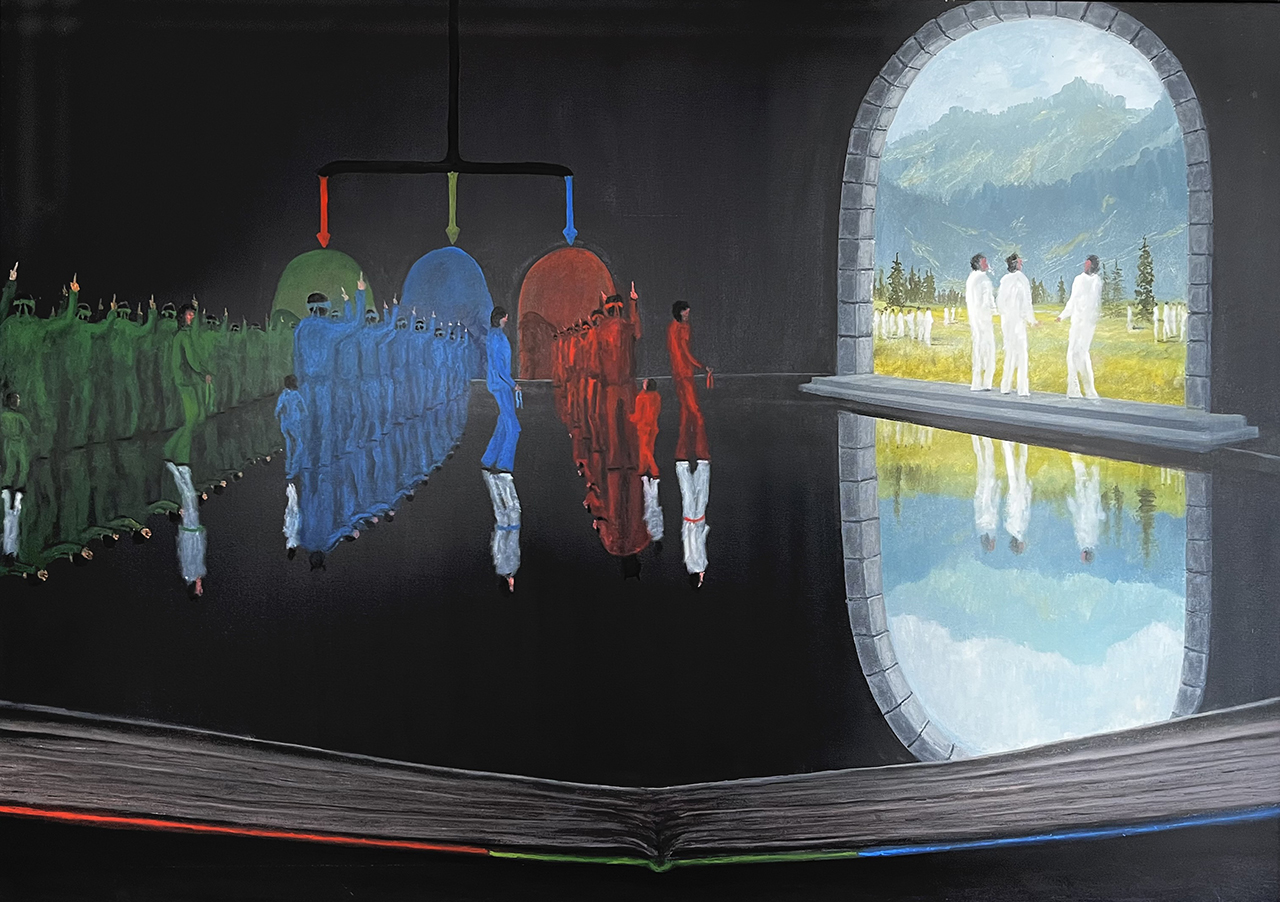
The painting “The Gate of Abraham” visualizes this philosophy:
The Book: Represents universal truth and reason.
Colors and White: The combination of the three primary colors of light (Red, Green, Blue) in physics creates white. White symbolizes the unifying universal truth.
Virtual Gates: Gates created with incorrect color sequences represent dogmatic paths accepted without question.
The Blindfold: Represents the prejudices that prevent people from seeing that others are also heading towards the same truth.
The Gate of Abraham: Represents the unified gate of truth that the inquiring mind ultimately reaches, embracing all colors (differences). Those who turn towards this gate shed their artificial identities (their colors) and attain pure truth (white).
Conclusion
True religion is not written in books, but in one’s own behavior program. “Islam” is one of the names of this universal program. “Muslim” is the potential identity for anyone who lives by this program. The Qur’an is a valuable reference because it presents this truth with a clarity not found in other texts. Abraham’s legacy is to question in order to seek the truth. Humanity’s task is to remove the blindfolds of dogma and, using their intellect, find “The Gate of Abraham.” That gate is not the gate of colors that divide us, but the gate of light that unites us all.
You can read this article in the following languages: